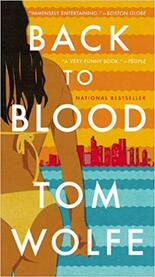
Tom Wolfe, with his perceptive eye and eloquent pen, was a Charles Dickens and Mark Twain for our time. He not only satirized patrician vices and eulogized plebeian virtues to devastating effect, but also created many unique expressions which enriched the language. Wolfe was born on March 2nd, 1930, in Richmond, Virginia. He was accepted to Princeton, but attended Washington and Lee because he wished to stay close to home, and when he left for graduate school at Yale, he hated it. Wolfe enjoyed writing and had already developed a signature style in college (his dissertation on the organizational activities of the Communist Party in American literature had to be rewritten because it was too colorful), but after doing some workmanlike reporting in Springfield, Massachusetts, and Washington, D.C., he grew bored and moved to New York City. There, writing for The New York Herald Tribune and New York Magazine, was where he broke out and wrote some of his most iconic pieces. Articles such as “Radical Chic and Mau-Mauing the Flak Catchers” and “The ‘Me’ Decade and the Third Great Awakening” quickly turned Wolfe into the sort of writer that people bought whole publications just to read. Of all Wolfe’s journalism during this period, The Right Stuff (originally serialized but ultimately republished as a book) is the most impressive: he spent years traversing the country talking to whomever he could, and the result was not just a timely history of Project Mercury, but an intimate portrait of the lives of the first astronauts as well. Wolfe’s first novel, The Bonfire of the Vanities, was a critically acclaimed bestseller, as was his much-anticipated second novel, A Man in Full. In “Stalking the Billion-Footed Beast: A Literary Manifesto for the New Social Novel,” published in Harper’s Magazine shortly after The Bonfire of the Vanities, Wolfe responded to his critics, arguing that the role of a novelist was to “document” real life – an opinion popular with many readers but unpopular with many other writers. Sadly, but after a well-lived life stretched over 88 years and packed full of adventure, Wolfe died on May 14, 2018. In Wolfe’s last novel, Back to Blood, he asked the question, “Could Miami with its clash of cultures be the American city of the future?” In an interview with The Telegraph, Wolfe explained his motives behind writing such a book:
Cubans are one of the largest immigrant groups to the U.S.A., comprising 3% of the entire immigrant population. Mass-immigration from Cuba began in 1959 after the Cuban Revolution. Cubans being refugees from a Cold-War enemy, the U.S.A. expedited their immigration. In the 1960s alone, the Cuban-immigrant population in the U.S.A. increased nearly 600% – from 79,000 to 439,000. The Cuban-immigrant population continued to rapidly increase, to 608,000 by 1980, 737,000 by 1990, 873,000 by 2000, and 1,105,000 by 2010. Between 1995 and 2015, when the “wet foot, dry foot” policy was in effect, 650,000 Cubans immigrated to the U.S.A. Today, there are approximately 1,272,000 Cuban immigrants living in the U.S.A., with 78% in Florida and 64% in Miami. Originally, Back to Blood was going to be about the Vietnamese in Orange County, California (which has also been demographically transformed by virtue-signaling and pathologically altruistic immigration policies from the Cold War), but became interested in Miami when he learned about the scope of the population replacement that has taken place there and that its government is now entirely under the control of Cubans. Wolfe brought his signature style of journalism-turned-fiction to Back to Blood, doing lots of legwork to learn about his subject from the bottom up; the result are lots of little details that make his big picture feel real. He was shown around the city by a Cubano reporter, an Anglo police chief, a Haitian anthropologist, and more. The reporter made a PBS documentary about Wolfe’s research process for the novel, “Tom Wolfe Gets Back to Blood.” Three of the novel’s most striking chapters – set in a regatta gala, an art show, and a strip club – are drawn from Wolfe’s own firsthand experiences. Edward T. Topping IV, the Anglo editor of The Miami Herald, sets the stage as he recollects how and why he ended up in this city where he is so uncomfortable:
Indeed, the novel’s title and theme also come from Ed’s stream of consciousness:
Ed is a thoroughly conventional liberal who wallows in fear and self-hatred. In quasi-1984 fashion, Ed self-censors his politically incorrect thoughts, although as a writer, he often winces at the damage that political correctness has done to the English language. “Aw, shit, the kid is PC…the way he almost said ‘him’ and switched it to ‘person’ on the edge of a cliff…and then gave up on ‘person’ for ‘they,’ so he wouldn’t have to deal with the gender in the singular, the ‘hims’ and ‘he’s,’” Ed thinks when talking to a young reporter. “I fucking don’t want to believe it was Yale that made my man here mangle the goddamn English language this way.” When his wife gets into a racially charged shouting match with a Latina who stole their parking space, Ed cringes. “‘Herald Editor’s Wife in Racist Rant.’” he imagines the headlines. “He could write the whole thing himself.” Anglos like Ed are the only people in Back to Blood who have little to no sense of self-consciousness or self-confidence. In Back to Blood, figurative human sacrifices are necessary to keep the peace in Miami. For following orders, risking his life, and saving the life of a Cuban refugee, Nestor Camacho (a Cubano cop), is actually punished in just to appease the outraged Cubanos, to whom any deportation of one of their own is an unforgivable offense. In one of the novel’s most striking passages, the mayor, Dionisio Cruz (who is Cubano), explains to the police chief, Cyrus Booker (who is black), Miami’s conflict between democracy and diversity:
Nestor is, privately, medaled for his bravery and reassigned from the Marine Patrol to the Crime Suppression Unit. When a recording of Nestor insulting a subdued black criminal spreads online, Dio demands his head. Cy, however, argues that the recording was taken out of context: Nestor had just saved the life of another cop, whom the criminal had nearly killed. “You know very well that one of the main reasons you were made chief was that we thought you were the man to keep the peace with all these – uh, uhhh – communities,” Dio snaps back at Cy. “So you think I’m gonna stand by and let you turn racial friction into a goddamn conflagration on my watch?” Cy knows that amongst themselves, Cubanos like Dio differentiate themselves from the Anglos, but amongst other races – such as “African-Americans” like Cy – the Cubanos define themselves as white:
Miami is now known as “the Capital of Latin America,” or as Wolfe puts it, “Plan B for everyone in Latin America.” When Ed’s wife yells at the Spanish-speaking Latina that she is in America and so should speak English, the Latina laughs in reply, “No, mia malhablada puta gorda [you impudent fat bitch] – we een Mee-ah-mee now! You in Mee-ah-mee now!” Later, when the Cubano cop Nestor and an Anglo reporter John Smith, drive out of Miami into Broward County (which is hardly the American heartland), they can both sense a change:
(By the way, the character “John Smith” is always referred to by his full name, “John Smith” – never “John” or “Smith.” It is not just that it is an archetypical name among “Anglos” (i.e. White Anglo-Saxon Protestants), but that it is also name of the original American and Virginian, Captain John Smith.[1]) In Back to Blood, everybody does indeed hate everybody, as Mayor Dio explained. Everybody does not just hate everybody, but everybody hates everybody over everything, too – not just over cultural and social differences or economic and political conflicts, but even over the most superficial things, such as how other races dress or speak. Nestor, for instance, is irritated by the clothes that his partner, John Smith, wears. “The Americano stood there dressed so Americano, it was annoying,” he thinks to himself. This instinctive awareness of and animus toward other races is exemplified by Magdelana Otero, a Cubano nurse who is prejudiced against any Americano she meets, no matter how friendly or helpful:
Wolfe’s portrait of Miami’s Cubans makes a mockery of Americano confidence in immigrant assimilation, particularly Republicans’ belief that Latinos are “natural conservatives.” If any Latinos were going to assimilate, it would be the Cubans, who are given extra-preferential immigration status (they are automatically legalized as soon as they enter the U.S.A., even illegally), are eligible for affirmative-action privileges (originally intended as one form of reparations to blacks for white discrimination), and are one of the most powerful foreign-policy lobbies in the U.S.A. (as vengeful to their homeland as the Israel Lobby is to the Palestinians). Yet Wolfe shows that these Cuban-“Americans” do not identify as Americans at all. “Americano” is not a term that they ever apply to themselves – they are Cubanos! – but is basically a racial epithet against “Anglos.” While patrolling Biscayne Bay with two other cops – Americanos – Nestor considers the irrationality of these racial categories:
As far as Miami’s Cubanos are concerned, the sole business of the U.S. government should be to transfer the population of Cuba to Miami and overthrow the Cuban government (and, as a voter bloc, they present a united and uncompromising front on this issue). There is no gratitude toward the Americanos for rescuing them, however, just entitlement and resentment. Indeed, Ed not-so-fondly recalls the Cubano blowback to one of his first big stories at The Miami Herald:
Amongst themselves, moreover, the Cubanos expect and enforce tribal loyalty. When Nestor saves the life of a Cuban refugee (but, in the process, deprives him of automatic asylum due to the U.S.A.’s “wet foot, dry foot” policy), he is cast out not just by other Cubanos, but by his own family as well. “DETENIDO! 18 METROS DE LIBERTAD,” announces the front page of the El Nuevo Herald. “A Cuban refugee, reportedly a hero of the dissident underground, was arrested yesterday on Biscayne Bay just eighteen meters from the Rickenbacker Causeway – and asylum – by a cop whose own parents had fled Cuba and made it to Miami and freedom in a homemade dinghy.” Nestor briefly takes some pride in The Miami Herald’s more neutral headline (which highlights the fact that what happened was a “rescue,” after all) only to remember what the Cubanos say: “Yo no creo el Miami Herald” – “I don’t believe The Miami Herald.” When Nestor comes home to Hialeah after he is on the news, he is told that he has dishonored the family name:
Later, at his grandmother’s birthday party, Nestor is berated even by distant relatives:
Back to Blood, though about race in the main, also includes the other American anxieties of class and sex which Wolfe so often satirized. Magdalena, a Cubano nurse, is an ambitious social climber who uses her body to get what she wants from men, yet is unaware that men are only using her for her body to get what they want. While Magdalena is having sex with Nestor, she starts having sex with Norman, and while she is with Norman, she starts having sex with the gangster-turned-philanthropist Sergei Korolyov, and after she realizes that Sergei has disposed of her, she tries to get back with Nestor again. Norman, an Americano psychiatrist who treats sexual disorders, is an ambitious social climber who uses his rich and famous clients to increase his own public profile. Norman is cocky, petty, and creepy: he lies to make himself seem like more of a celebrity than he is, puts down Magdalena’s weaker grasp of the English language, and is in denial about his own sex addiction. One of the most interesting characters in the novel is Professor Antoine Lantier, a light-skinned Haitian-American linguist. Lantier, who identifies as French (he is apparently descended from old Norman aristocracy) and considers himself to be a bearer of Western Civilization, is disgusted with the primitive black Haitians from whence he came. Lantier’s greatest hope is for his light-skinned daughter, Ghislaine (who is cultured, educated, and innocent), to “pass” as white, while his greatest disappointment is that his darker-skinned son, Philippe, identifies as black. “Right now he wants to be a Neg, a black Haitian,” Ghislaine says of Philippe, “and they want to be like American black gangbangers…and I don’t even know what American black gangbangers want to be like.” Wolfe’s journalism, in addition to influencing how he wrote, also influenced what he wrote. For years, Wolfe followed the emerging field of “sociobiology” as well as rapid advances in the field of neuroscience (e.g. “Sorry, But Your Soul Just Died” and “Digibabble, Fairy Dust, and the Human Anthill”). Wolfe, who had himself been the target of ideological purges by the literati (because of his populist literary philosophy which criticized elitist literature), took particular pleasure in ridiculing the malcontents of neuroscientific progress. “If I were a college student today,” admitted Wolfe, “I don’t think I could resist going into neuroscience.” Accordingly, in I Am Charlotte Simmons, published a few years after these essays, the title character takes classes on neuroscience, which she sees as the most cutting-edge and wide-open field of study. Likewise, parts of Back to Blood are clearly influenced by Wolfe’s earlier journalism on the faddishness of modern art and architecture, summed up in his books, The Painted Word and From Bauhaus to Our House. In his chapter on Art Basel Miami Beach, “The Super Bowl of the Art World,” ignorant wealthy collectors, advised by self-interested art dealers, mindlessly compete for tasteless and otherwise worthless works of art. Maurice Fleischmann, a pornography-addicted Jewish billionaire, spends $17 million in 15 minutes on “No-Hands” and “De-Skilled Art” –an artist hired someone else to take pictures of him having sex with a prostitute, then hired someone else to etch the photographs into glass, and did not even touch the photographs when they were sent or the etchings when they were received. “And there you’ve got the very best, the most contemporary work of the whole rising generation,” Fleischmann’s art dealer, “A.A.” tells him. “Maurice…you…have…really…scored this time.” Magdalena thinks to herself, “Fleischmann looked very pleased, but his smile was the baffled smile of someone who can’t explain his own good fortune.” Wolfe was sometimes labeled a reactionary railing against changes which he did not understand. Oftentimes, however, his critics did not understand the changes that they were idly accepting and applauding. For instance, Slate’s Stephen Metcalf denounced I Am Charlotte Simmons as “an eminently foolish book, by an old man for whom the life of the young has become a grotesque but tantalizing rumor.” Metcalf, with all the wit of the sophomore-cum-philosopher, pronounced, “The stupidity here may actually be boundless.” What Metcalf seems not to have known, however (probably because, to him, any moral criticism of anything is puritanical), is how degenerate campus life had actually become. By contrast, when the judge-turned-professor Richard Posner first read The Bonfire of the Vanities, he commented that “it didn’t strike me as the sort of book that has anything interesting to say.” Yet after the Tawana-Brawley rape hoax, the arrest of the bond-trader Michael Milken, the Crown-Heights riot, the Rodney-King riot, and the O.J.-Simpson trial (all of which Wolfe had anticipated in some form in that 1987 novel), Posner changed his opinion, admitting that he had been “ungenerous and unperceptive.” Wolfe was never a reactionary, however, neither a nativist nor a xenophobe. On the contrary, Wolfe, like many members of the Baby-Boomer generation, celebrated the U.S.A.’s post-1965 immigration wave as proving, once and for all, that Americans were not the racists that American “Rococo Marxists” (or “sweaty little colonials forever trying to keep up with Europe and, above all, France”) claimed that they were:
In fact, Wolfe celebrated mass-immigration as a natural outgrowth of “The American Idea,” reified in the open, equal seating arrangements at Pres. Thomas Jefferson’s state dinners (described by the British ambassador and his wife as “pell-mell”):
Ironically, however, the “Rococo Marxists” whom Wolfe so deftly ridiculed got the last laugh, benefiting enormously from the worldwide immigration wave to the U.S.A. If mass-immigration discredited their paranoia about non-existent American “isms” and “phobias,” as Wolfe rather optimistically predicted, then they have been too busy enjoying the importation of loyal activists and obedient voters to realize it. As a recent article in The New York Times, “Why the Announcement of a Looming White Minority Makes Demographers Nervous” notes, the policies that are changing the U.S.A.’s demographics have made the Left complacent and triumphalist about the future:
The new Rococo-Marxist Congress (which, if not “the blue wave” of expectation, is still “the most diverse ever”) is a prelude to that “demographic destiny,” with the Rococo-Marxist Alexandria Ocasio-Cortez as its arrogant, ignorant face. Conservatives and libertarians criticize Ocasio-Cortez’s “Democratic Socialism,” “Green New Deal,” and “Modern Monetary Theory” as if she is driving these ideas herself, but she is merely representative of the demographic shift that is driving the political shift. Now that “all politics is identity politics” (this is a truth which diversity brings to light), it does not really matter if Ocasio-Cortez represents a “rotten borough,” lies about her upper-middle-class background, and dismisses any criticism as prejudice. All that really matters, in her own words, is whether she represents her tribe (“intersectional working-class Ocasio voters”) against other tribes (“homogenous working-class Trump voters”). If Back to Blood is correct that Miami is “the city where America’s future has arrived first,” then America’s future has arrived in Ocasio-Cortez. (Ocasio-Cortez, whose high opinion of herself actually seems to increase with each passing blunder, would have made a memorable character in one of Wolfe’s novels.)
Only late in his life, in Back to Blood, did Wolfe seem consider the consequences of “people of every land, every color, every religion…pouring into the United States.” As Wolfe put it, “This is a book about immigrants in America and the way in which immigrants change life in America.” Yet the question is why would anyone want to live in such a city, let alone such a country? What took place, perhaps, with Wolfe (and what is certainly taking place with Americans), is a “great relearning” on the issue of immigration – a vital issue which has, lately, been governed more by schmaltz than sense. In “The Great Relearning,” Wolfe argued that the 20th century was defined by intellectual movements and political activism which “swept aside all rules and tried to start from zero.” In architecture, there was the Bauhaus School, which resulted in sterile buildings ugly at which to look and uncomfortable in which to live. In culture, there was the hippy subculture, the communal living of which quickly resulted in rare disease outbreaks. In morality, there was the Sexual Revolution, which resulted, frankly, in AIDS. In politics, there was Communism, which resulted in dysfunction and repression. Optimistically, as was his nature, Wolfe predicted that Americans were looking back on “the amazing confidence, the Promethean hubris, to defy the gods and try to push man’s power and freedom to limitless, god-like extremes” and learning their lesson. Likewise, in 1965, the qualitative and quantitative regulations which had controlled immigration since 1924 were ceremoniously abolished. The Johnson-Reed Act of 1924, itself the culmination of a series of increasingly selective and restrictive acts from the late-1800s and early-1900s, established a system of national-origins quotas which ensured that the immigrants would be of assimilable character and number. In 1952, the McCarran-Walter Act repealed some of the outright racial discrimination in the 1924 act (citizenship was limited to whites only), but otherwise retained the national-origins quota system. Yet by 1965, the idea that a foreign country’s immigrant quota should be proportional to the percentage of its people among the host country’s population was considered “discriminatory,” at least according to the politicians. Not so much the people, however: “U.S. Public is Strongly Opposed to Easing of Immigration Laws,” reported The Washington Post, citing a Harvard-Harris survey of 58% to 24%, but the politicians had already set their brains to zero. It was not all a “Great Unlearning,” however; there was plenty of base politicking. For one, there was Rep. Michael A. Feighan of Ohio, who as chairman of the House’s immigration subcommittee agreed to stop obstructing the act in exchange for prioritizing family reunification over skills, so that he could pander to the labor unions (which did not want to compete with skilled foreign labor) and Eastern-European blocs (which wanted to import more of their own people) in his district. For another, there was Sen. James O. Eastland of Mississippi, who as chairman of the Senate Judiciary Committee also agreed to stop obstructing the act, seemingly for no other reason than as a personal favor to the President and the Kennedys. More common, however, was the well-meaning gullibility and high-minded sanctimony typical of a “Great Unlearning.” Sen. Eugene J. McCarthy of Minnesota, for example, declared that while the act was “a recognition of the great contribution made to the development of our nation by peoples from all regions of the world” and “reflects a fundamental principle in our laws and traditions: that of the equality of nature of all men,” he also believed that it “would not greatly increase the number of immigrants, but it would provide that those admitted would be judged on the basis of a national-origins quota.” (McCarthy later admitted that he and his colleagues had “never intended to open the floodgates” and that they had made a terrible mistake.) In a ceremony at the Statue of Liberty, Pres. Lyndon B. Johnson signed the Hart-Celler Act into law with reassuring words. “The bill that we sign today is not a revolutionary bill,” he explained. “It will not reshape the structure of our daily lives, or really add importantly to our wealth or power.” According to Johnson, “The days of unlimited immigration are past, but those who do come will come because of what they are, and not because of the land from which they sprung.” (In the same speech, Johnson announced that Cuban refugees would continue to receive their privileged treatment.) The “Great Relearning” began when the character of immigrants started changing and the number of immigrants started rising, which was not ever supposed to happen. The bill’s sponsors, Rep. Emanuel Celler of New York and Sen. Philip A. Hart of Michigan, along with many other confident Congressmen, had predicted that their reform would have no such effect and had dismissed their opponents as mere contrarians and cynics. Sen. Edward Kennedy of Massachusetts and Sen. Robert Kennedy of New York had made an effort to “set to rest any fears that this bill will change the ethnic, political, or economic makeup of the United States,” while also attacking criticism of the bill as “emotional, irrational, and with little foundation in fact…out of line with the obligations of responsible citizenship.” LBJ-Administration officials, such as Attorney-General Nicholas D. Katzenbach, Secretary of State D. Dean Rusk, and Secretary of Labor W. Willard Wirtz, had been called to the Congress to testify the same: there would be no noticeable difference in the quality or quantity of immigrants, and anyone who suggested so was suspicious. John F. Kennedy himself, in his highly romanticized and sentimentalized Nation of Immigrants (published by the Anti-Defamation League in 1958), had avowed that he “does not seek to make over the face of America.” Yet the Hart-Celler Act that is remembered today for exactly that – for making over the face of America. The Pew Research Center’s timeline of the racial composition of the American population, “The Changing Face of America,” begins in 1965, the year Hart-Celler became law. In a report on Hart-Celler, “1965 Immigration Law Changed Face of America,” NPR’s Jennifer Luden described how “it marked a radical break with previous policy and has led to profound demographic changes in America.” At the Migration Policy Institute’s 2015 symposium in honor of Hart-Celler, Muzaffar Chisti explained that it “literally changed the face of America.” According to Chisti, Hart-Celler “ushered in far-reaching changes that continue to undergird the current immigration system, and set in motion powerful demographic forces that are still reshaping the United States today and will in the decades ahead.” A recent book by Peggy Orchowski on the 50th anniversary of Hart-Celler, “The Law that Changed the Face of America,” argues that “this historic law that made the United States the highly diverse nation of immigrants that it is today.” The American people quickly learned about the unintended consequences of policies such as “birthright citizenship,” “chain migration,” “diversity lotteries,” “refugee protocols,” “workers visas,” and more. Reforms were passed in 1986 and 1996, but they were half-hearted and simple-minded, and only worsened the problems by delaying the necessary solutions. Further reforms were attempted in 2007 and 2013, but these were so transparently exploitative that they did not even manage to pass. In 2012, Pres. Barack Obama took it upon himself to decree amnesty for the children of all illegal immigrants, resulting in a surge of illegal immigration at the southern border still ebbing and flowing seasonally. In 2016, Donald Trump (a world-famous businessman, celebrity, and demagogue) ran a self-funded presidential campaign with an “isolationist,” “protectionist,” and “nativist” message, including not only the revocation of Obama’s amnesty but also the construction of a wall along the southern border. Since his stunning victory, however, he has struggled against bipartisan resistance at every turn, even in his by-the-book efforts to enforce the law at the national border. Early in 2018, when Pres. Trump was making a major attempt to negotiate a deal with the Congress, a Harvard-Harris poll found that not only did a substantial majority of 65% (cutting across dividing lines of class, race, and sex) support his position of trading amnesty for reforming the system and boosting border security, but also that an even greater majority of 81% supported reducing immigration levels. One year later, just days before Pres. Trump caved on the government shutdown, another Harvard-Harris poll found that immigration, at 38%, was the single most important issue to the public (and while his proposed border wall was opposed by 55% to 45%, there was more support for other border-security measures, including a “security barrier”). Yet when it comes to immigration reform, the Democrats and the Republicans are less responsive to and less representative of public opinion than the Bourbons and the Romanovs. What the American people are “relearning” – and Back to Blood is a sign of the times – is that nothing comes free, especially not immigration. Like every other policy, immigration has costs as well as benefits, losers as well as winners, and so on. Indeed, how could a policy which literally determines the composition of a country’s population – and populations are not merely interchangeable masses – be anything less?
0 Comments
 “The Declaration of Independence is to be taken with a great qualification. It declares those men have an inalienable right to life; yet we hang criminals – to liberty, yet we imprison – to the pursuit of happiness, yet we must not infringe upon the rights of others. If the Declaration of Independence is taken in its fullest extent, it will warrant robbery and murder, for some may think those crimes necessary to their happiness.” – Rep. Joseph Clay of Pennsylvania on the slave trade (1806) “I should not have noticed this strange and ridiculous vision, that the Declaration of Independence was a decree of universal emancipation, had it not issued from respectable sources, and been seriously enforced upon the credulity of the public. Instead of attempting to answer or refute these visions of a disturbed imagination, let us recur to principles and facts.” – Rep. John Holmes on the Missouri Crisis (1820) “I cannot, in the first place, believe that Mr. Jefferson ever intended to give the meaning or force which attempted now to be applied to this language when he said, ‘We hold these truths to be self-evident, that all men are created equal.’ I hold it to be a self-evident lie…I speak what is the judgment of all men, if they dare say it, that neither morally, mentally, socially, physically, nor politically, does equality exist in any country on the earth. It cannot exist in the nature of things. God himself has not created them equal. It is not, therefore, a truism, as Jefferson put it forth, but is false in form, and false in fact.” – Sen. John Pettit of Indiana on the Kansas-Nebraska Act (1853) “The object of that war was to disenthrall the united colonies from foreign rule, which had proved to be oppressive, and to separate them permanently from the mother country. The political result was the foundation of a federal republic of free white men of the colonies, constituted, as they were, in distinct and reciprocally independent State governments. As for the subject races, whether Indian or African, the wise and brave statesmen of that day, being engaged in no extravagant scheme of social change, left them as they were, and thus preserved themselves and their posterity from the anarchy and the ever-recurring civil wars which have prevailed in other revolutionized European colonies of America.” – Pres. Franklin Pierce of New Hampshire in the State of the Union (1855) John Dickinson, known as the “Penman of the Revolution” for his “Letters from a Pennsylvania Farmer” essays, as well as his “Petition to the King,” “Olive Branch Petition,” and “Declaration of the Causes and Necessity of Taking Up Arms,” ultimately refused to sign the Declaration of Independence. His objections had nothing to do with the ways in which the Declaration could be perverted by posterity, but were entirely pragmatic concerns about whether the American Colonies were prepared for war and whether their supposed allies in Europe would actually come to their aid. If he had any idea, however, that the Declaration – at the time, nothing more than an act of secession – would one day be cited to justify transforming his free and independent country into a “Colony of the World,” where immigration policy was conducted in the interest of alien immigrants first, economic policy was conducted in the interest of multi-national businesses first, and foreign policy was conducted in the interest of foreign states first – never “America First” – then Dickinson would not have been the only delegate who refused to sign it; not a single delegate would have signed such a suicide pact. The so-called “equality clause” of the Declaration of Independence is neither about “equality” (at least not as in the equalitarian “capital-E” sense) and is not even a “clause.” Calling this phrase plucked from the second paragraph a “clause” is meant to invest it with constitutional authority – to make it a mandate, so to speak. The Development of Neo-Conservatism in America It is the neo-conservatives, or “neocons,” who want to make this “equality clause” a mandate. The neocons are a clique of ideologues who have become highly influential in both parties – the Evil Party and the Stupid Party (you figure out which is which). They are not normally politicians, but rather advisers and speechwriters influencing elected officials, or appointees to powerful but unseen positions. They are journalists spinning and slanting stories, pundits supplying prepackaged opinions and fueling ready-made outrage, financiers funding campaigns and foundations, wonks ensconced in think tanks inventing policy initiatives, and so on. They infiltrate institutions, subvert their values, and appropriate their identities. “Neocon” is a term that most Americans first heard during the Bush Administration, when that clique was at the height of its power. Dimwitted “Dubya” was desperate to “do something” after 9/11, and the neocons were ready and waiting with a plan, the same plan that they had been pushing on presidents since the end of the Cold War: now that the Soviet Union was no longer a rival empire, the U.S.A. and Israel could unilaterally intervene in the Middle East. Paul Wolfowitz, Douglas Feith, Richard Perle, Elliott Abrams, and David Wurmser were a few of Bush’s highest-placed neocons, though many more were crawling in and out of the administration. Most of them were members of Project for the New American Century (a think tank which advocated “a Reaganite policy of military strength and moral clarity” and obsessively urged “the removal of Saddam Hussein’s regime from power”) and some of them were authors of “A Clean Break: A New Strategy for Securing the Realm” (the report of an Israeli study group which recommended reestablishing the “principle of preemption” to “contain, destabilize, and roll back” Iran, Iraq, Lebanon, Syria, and Palestine). The neocons were the architects of “the War on Terror,” which should go down in history as the most notorious example of what the Old-Right thinker and writer Samuel T. Francis called “anarcho-tyranny” – a dystopia unforeseen even by Orwell, Huxley, and Bradbury, in which the government does not do what it should do but does do what it should not do. In other words, anarcho-tyranny is when the government, whether through mere incompetence or sheer malice, permits widespread lawlessness (“anarchy”) and commits abuses of power (“tyranny”). While the beneficiaries of anarcho-tyranny are the dysfunctional, dependent underclass and the established, elite managerial class, the victims of anarcho-tyranny are law-abiding, tax-paying, “Middle-American” citizens trapped between the anarchy from below and tyranny from above. 9/11 was committed by radical Sunni fundamentalists, so what did the neocons do? They declare war on the secular powers in the Middle East who had been on the front lines fighting radical Sunni fundamentalists for years. 9/11 was committed by illegal immigrants who overstayed their visas, so what did the neocons do? Instead of establishing an entry/exit visa system to prevent such oversights, they have repeatedly undermined the enforcement of immigration laws and even tried to sneak through amnesty. 9/11 was committed by Muslims from foreign countries, so what did the neocons do? Instead of using statistical probabilities to “profile” potential terrorists, all American citizens were subjected to a regime of snooping and bullying. A real “War on Terror” would have meant forming a grand alliance between Iraq, Syria, and Iran (a triumph of statesmanship of which the jingoistic, chauvinistic neocons would certainly have been incapable) to wage a moral crusade against the two chief destabilizers of the Middle East, Saudi Arabia and Israel. The neocons were also the architects of the Iraq War – not just the waging of the war itself (although in many cases these eggheads and pinheads did indeed overrule the actual military brass), but more importantly, the case for the war. The fraudulent case for the Iraq War – that if Saddam Hussein, an evil dictator and state sponsor of terrorism, were overthrown, then the Middle East would become safer and freer – was the fault not only of the neocons’ arrogance and ignorance, but also of their dishonesty and disloyalty. Just recently, the political party of Moqtada al-Sadr (a radical Muslim cleric who led the insurgency against American occupation), won a plurality of seats in the Iraqi elections. The Iraq War is going to go down in history as the greatest catastrophe in the Middle East since the collapse of the Ottoman Empire. Just recently, the neocons have been leading resistance to Donald Trump from within the Republican Party, not because they have any moral qualms about his character or his competence, but because Trump is an old-fashioned populist and nationalist who, in the course of the primaries and the general election, clearly rejected their designs of “world policing” and “nation building.” The founding generation of the neocons came from two factions of the American Old Left: Communist exiles (specifically, Trotskyites who were ousted by Stalin in the power struggle after Lenin’s death) and Cold-War liberals (Democrats like Sen. Henry Jackson of Washington). The proto-neocon Trotskyites were organized around Max Schachtman, a Polish-Jewish immigrant involved with the AFL-CIO and the Democratic Party. The far-left Schachtmanites, alarmed by Stalinist imperialism and “anti-Semitism,” supported the U.S.A. countering the USSR militarily and creating the State of Israel as a national home for Jews. The Schachtmanites began as Trotskyites who believed that “the maintenance of the dictatorship in one land was dependent on the extension of the proletarian revolution on a world scale,” but ended up as anti-Communists who believed that “U.S. power could be used to promote democracy in the Third World” (and thus supported the bungled invasion of Cuba and the Vietnam War). Interestingly enough, a superpower imposing its ideology on other countries is a constant throughout every phase of Schachtmanite thought, from hardcore Communism to hardcore anti-Communism. The proto-neocon Cold-War liberals were organized around Leo Strauss, a German-Jewish immigrant who became a sort of rabbinical figure to “social democrats.” They were for supporting “the New Deal” at home and fighting Communism abroad, which to them meant not only militarily countering Soviet expansion, but also promoting mass-immigration to the U.S.A. in order to signal to the Third World that they were more humanitarian than the USSR. Irving Kristol and Norman Podhoretz, both Straussians, founded the now-neocon Commentary and The Public Interest as center-left, social-democratic publications for liberals who wanted “to return to the original sources of liberal vision and liberal energy so as to correct the warped version of liberalism that is today’s orthodoxy.” There were two events in the 1960s and 1970s which resulted in these different factions of the Old Left coming together to reinvent themselves as “conservatives.” The first was when the USSR became officially anti-Zionist, aligning with the Arab states against Western powers and their ally, Israel. In the 1967 war, for instance, the Soviets were on the side of the Arabs, whom they had been arming and advising, and represented them in cease-fire negotiations with the U.S.A. The 1967 war – and the fear of another “Holocaust” – reinvigorated the ethno-religious roots of these proto-neocons, who realized that they cared less about their ideology than they did their identity and that the future of their ethno-state depended on the U.S.A. The second was when the “New Left” displaced the “Old Left” in the Democratic Party. The New Left cared less about the “hard” economic and social doctrines that animated the Old Left, and more about “soft” cultural issues such as diversity, pluralism, and tolerance. The candidacies of the anti-war George McGovern and the race-baiting Jesse Jackson disgusted these proto-neocons, who longed for the presidencies of Franklin D. Roosevelt and Harry S. Truman. In addition, and probably most importantly, the New Left was pro-Soviet and anti-Zionist, expressing solidarity not just with the Palestinians against Israel, but with any Third-World revolutionaries against capitalist and imperialist powers. Reacting to Israel’s geopolitical situation and their loss of influence in the Democratic Party, the Old Left defected, so to speak, to the Old Right, where they immediately clashed with existing conservatives (now known as “paleo-conservatives,” i.e. “old conservatives”). These “neo-conservatives” (i.e. “new conservatives”) did not want to assimilate to the Old Right, but rather to deconstruct and redefine it into a host for their preexisting center-left, social-democratic, anti-Communist, pro-Zionist ideologies. The “paleo” and “neo” prefixes should indicate which side won. While paleocons were traditionalists, neocons were ideologues. Paleocons believed, in Russell Kirk’s phrase, that they had a responsibility “to preserve a particular people, living in a particular place during a particular time.” Neocons, like right-thinking Marxists, believed in carrying certain principles – or “propositions” – to their logical conclusions, no matter the human cost. Paleocons believed, again in Kirk’s phrase, in maintaining “custom, convention, and continuity.” Neocons believed in the moral abstractions devised by “classical liberals” during the Enlightenment, “free minds, free markets, and free people.” Paleocons did not have detailed “policy prescriptions,” as did the neocons. As Kirk put it, conservatism was properly an “adjective,” describing “a state of mind, a type of character, a way of looking at the social order,” and was thus “the negation of ideology.” By contrast, the “think tank,” an industrialized ivory tower which manufactures opinions like a factory manufactures widgets, is a distinctly neocon invention. Neocons were “painfully deficient,” according to Kirk,” in the understanding of the human condition and in the apprehension of the accumulated wisdom of our civilization,” instead preferring “to engage in ideological sloganizing.” The paleocons never really stood a chance against this Catilinarian conspiracy. The neocons were far shrewder and fiercer than the paleocons, who were, chiefly, scholarly and gentlemanly types unprepared for the neocons’ verbal brawls and power grabs. “Eager for place and preferment and power, skillful at intrigue, ready to exclude from office any persons who might not be counted upon as faithful to the neo-conservative ideology,” Russell Kirk summed up and put down the neocons. “Often, backstairs, they have seemed more eager to frustrate their allies than to confute those presumptive adversaries the liberals and radicals.” Indeed, this network of neocon pundits, politicos, professors, and outright plutocrats has remade the Right into something unrecognizable – a cartoonish band of free marketeers like Jack Kemp and Paul Ryan, armchair militarists like John Bolton and Dick Cheny, religious fundamentalists like Pat Robertson and Jerry Falwell, and amoral “consultants” like Karl Rove and Steve Schmidt (with the “traditionalist” paleocons blackened as “extremists.”) The fate of M.E. Bradford exemplifies the neocon takeover. In 1980, President Ronald Reagan announced that he was nominating Bradford, a professor of English at the University of Dallas, to chair the National Endowment for the Humanities. The neocons, who had long-coveted the cultural influence of the NEH, organized a smear campaign against Bradford, calling him a “neo-Confederate” for identifying with his Southern heritage and criticizing Abraham Lincoln. The neocon columnist George Will was particularly snide and insincere in his attacks on Bradford. “I’m through,” Bradford told his friend and colleague, Thomas H. Landess. “If they want it that bad to do something like this, then let them have it.” Ultimately, Bill Bennett, a Democrat who was friends with Bradford’s detractors, was appointed instead. Paul Gottfried, who also lost an academic position at due to neocon lobbying, described the neocons as “ideologically motivated pursuers of power” who “have never made a secret of their fear and loathing of that part of the Right which they cannot reshape or convert to their views.” The Lincolnian Revolution and the Renegade Neo-ConservativesBefore the neocons politicized American history, the Declaration of Independence was simply a significant, symbolic historical document with a clear textual and contextual meaning, to be studied by students and scholars as the culminating point of the American Revolution and honored by the public on the Fourth of July. Now it is endlessly “interpreted” and “reinterpreted” to divine mystical new “meanings,” as if it were the Talmud. The Straussian Harry V. Jaffa, repackaging the anti-slavery rhetoric of Abraham Lincoln for post-WWII Americans, invented what has become the kosher meaning of the Declaration, and by extension, the meaning of America herself – because countries cannot simply be “givens” anymore, but must be “propositions.” The neocon interpretation of the Declaration is, in fact, derivative of Lincoln’s own reinterpretation, and thus descended from what the biographer Edgar Lee Masters called “Hebraic-Puritanism” – the Manichaean, Millenarian, and “Old Testament” worldview of the Puritans. By the time of the Civil War, this Hebraic-Puritan mission had been secularized, but had (and has) lost none of its crusading zeal. Accordingly, “The Battle Hymn of the Republic” quite literally sanctifies the U.S.A. and demonizes its enemies: the abolitionist author sees “the glory of the coming of the Lord” in the Union military (“burnished rows of steel” are a “fiery gospel”), which is marching forward to “trample out the grapes of wrath,” “crush the serpent,” “sift out the hearts of men,” and “die to make men free.” According to Lincoln, the meaning of the Declaration is contained in the sacred words – “the Proposition” – that “all men are created equal.” From this sentence fragment, which he reinterpreted at once obtusely and abstrusely, the modern-day Lincolnites (i.e. neocons) have deduced, no less obtusely and abstrusely, what they call “the American Creed,” which proceeds as follows:
James Madison, Alexander Hamilton, and John Jay never mentioned any of the above in the Federalist. It is as if they never took any courses at Hillsdale College or PragerU! All that matters to the doctrinaire neocons is that one sentence fragment from the second paragraph – no need to read the rest of the document, and really no need to learn about the historical context of the Colonial Crisis, the Continental Congresses, the Revolutionary War, or really to learn about any American history for that matter. Once “the Proposition” is understood, all other truths are, mystically, revealed. The neocons are always lecturing about the “lessons” and “laws” of history, like right-thinking Marxists, yet it seems that the only history they know is this sole sentence fragment from the Declaration of Independence, the Gettysburg Address, the “New Colossus” poem on the Statute of Liberty, and, of course, Munich and Auschwitz. The neocon reinterpretation of the Declaration of Independence is a sort of historical fundamentalism – a simplistic and sentimental civic religion (or, to use a term more familiar to these Marxists, “false consciousness”) with little to no relation to human experience or even human reason. “They repeat, as the fundamental maxim of our civil policy, that all men are born free and equal, and quote from our Declaration of Independence,” Chancellor Harper explained as early as 1838. “It is not the first time I have had occasion to observe that men may repeat with the utmost confidence, some maxim or sentimental phrase, as self-evident or admitted truth, which is palpably false, or to which, upon examination, it will be found that they attached no definite idea.” It is indeed simplistic and sentimental: all men are most certainly not created equal. As individuals, human beings each have different capacities and characteristics determined by their genetic inheritance. For instance, cognitive ability, or “IQ,” has been demonstrated to be strongly predictive of life outcomes, and while not entirely heritable, still strongly heritable. Even the idea of “equality of opportunity” (as opposed to “equality of outcome”) is an illusion: just as a footrace in which some runners started ahead and some behind would not be considered “fair,” true “equal opportunity” requires an equal starting point for everyone, or “equality of outcome.” Yet in spite of the empirical untruth of the proposition “that all men are created equal,” Americans are seriously expected to live and die by it simply because Thomas Jefferson, writing under the heady influence of the Enlightenment, pronounced it so. Yet Jefferson was a member of a committee tasked with writing the first draft for a public statement of a resolution that the Continental Congress had already passed, not a Promethean lawgiver. According to John C. Calhoun, “that all men are born free and equal” was “a proposition which originated in a hypothetical truism, but which, as now expressed and now understood, is the most false and dangerous of all political errors.” Calhoun continued that he was “not afraid to attack error, however deeply it may be entrenched, or however widely extended, whenever it becomes my duty to do so,” and proceeded to refute this heresy in every particular: Taking the proposition literally (it is in that sense it is understood), there is not a word of truth in it. It begins with “all men are born,” which is utterly untrue. Men are not born. Infants are born. They grow to be men. And concludes with asserting that they are born “free and equal,” which is not less false. They are not born free. While infants they are incapable of freedom, being destitute alike of the capacity of thinking and acting, without which there can be no freedom. Besides, they are necessarily born subject to their parents, and remain so among all people, savage and civilized, until the development of the intellect and physical capacity enables them to take care of themselves. They grow to all the freedom of which the condition in which they were born permits, by growing to be men. Nor is it less false that they are born “equal.” They are not so in any sense in which it can be regarded; and thus, as I have asserted, there is not a word of truth in the whole proposition, as expressed and generally understood. All of the above is indeed contrary to the American civic religion of absolute individualism and egalitarianism, as preached by the Clintons and the Bushes, or the Washington Post and the Wall Street Journal, or Samantha Bee and John Oliver, or Jon Meacham and Eric Foner, or “The West Wing” and “The Newsroom,” but an “appeal to authority” is a logical fallacy (especially an appeal to such pathetic authorities). In what way was Calhoun wrong? “The act was, in fact, but a formal and solemn annunciation to the world that the colonies had ceased to be dependent communities, and had become free and independent States,” Calhoun wrote in his 1850 masterpiece. Even John Quincy Adams of Massachusetts, a proto-Lincolnite, quintessential Hebraic-Puritan, and one of Calhoun’s nemeses, did not disagree with the South Carolinian on this question. “The Declaration of Independence, in its primary import, was merely an occasional state paper,” Adams said on July 4th, 1821. “It was a solemn exposition to the world, of the causes which had compelled the people of a small portion of the British Empire, to cast off their allegiance and renounce the protection of the British king, and to dissolve their social connection with the British people.” This politicization of the Declaration of Independence can be traced back to the Missouri Crisis. When Southerners pointed out that the Congress had no constitutional authority to prohibit slavery in a new State, Northerners like Sen. Jonathan Roberts of Pennsylvania and Sen. David L. Morril of New Hampshire pointed out that slavery itself seemed to violate the so-called “equality clause” in the Declaration. Sen. Rufus King of New York, in particular, incensed Southerners with a forceful speech arguing that slavery was a violation of “the law of nature” and “the law of God,” which were, as he put it, one and the same. According to King, this law was “established by the Creator, which has existed from the beginning, extends over the whole globe, is everywhere, and at all times binding upon mankind: a law which applies to nations, because their members are still men; a law which is the foundation of all constitutional, conventional, and civil laws, none of which are valid if contrary to the law of nature; that according to this law all men are born free.” In his Second Inaugural Address (written by the neocon Michael Gerson, in consultation with other neocons and even the Israeli official Nathan Sharansky), Dubya took this same ideology and extended it globally – a perfect example of what Burke, in reference to the Jacobins, called an “armed doctrine.” Rep. John Tyler of Virginia (who would be President in 1841) argued that the phrase “all men are created equal” was a fallacy: Gentlemen have exultingly read to us the Declaration of Independence. From it they have gathered that which, as an abstract truth, I am not disposed to deny: “That all men are, by nature, equally free, sovereign, and independent.” Can this proposition admit of application to a state of society? Does not this fallacy meet you in every walk of life? Distinctions will exist. Virtue and vice, wealth and poverty, industry and idleness, constitute so many barriers, which human power cannot break down, and which will ever prevent us from carrying into operation, in extenso, this great principle. Take this principle and preach it up to the monarchs of the world; will they descend from their lofty eminences, or raise mankind to a level with themselves? No, sir, the principle, although lovely and beautiful, cannot obliterate those distinctions in society which society itself engenders and gives birth to. Liberty and equality are often captivating sounds; but they often captivate to destroy. England had her Jack Cades and Levelers. Look, I pray you, to revolutionary France. These were the principles of that day. Mark the consequences! Murder and rapine stalked over the land, and the guillotine, the work, too, of a philanthropist of that day, was the sad monument of this fallacy. Liberty and equality was proclaimed by Robespierre and his associates, at the very moment that they were enriching the fields of France with the blood of her citizens. Nor was the doctrine confined to political institutions, but, advancing with a daring step, fought even with the Creator, and mocked at the immutable truth of religion. Turn your eyes also to South America. The throne of the Incas was washed from under them by the tide which flowed in from Spain. The native of the forest was deprived of his freedom, and made to toil for his new master. Then, too, sprung up a philanthropist, who claimed for the Indian an equal rank in creation with the inhabitants of Spain. His claim was admitted, and Africa mourned over the mistake, and her deepest curses may still be uttered against the memory of Las Casas. “Although I do not believe that this principle of equality can be applied to man in extenso, yet I love it, and admire it as an abstract truth, and will carry it into operation whensover I can,” explained Tyler. “If we cannot raise the black man up to the level with the white – and that we have not the constitutional power to do so none here have denied – let us raise, at least, the white man up to this level,” he concluded. “Extend an equality of rights to the people of Missouri.” Sen. William Pinkney of Maryland argued that it was self-evident that the phrase “all men are created equal” was never meant to be taken so literally: Of the Declaration of Independence, which has also been quoted in support of the perilous doctrines now urged upon us, I need not now speak at large. The self-evident truths announced in the Declaration of Independence are not truths at all, if taken literally; and the practical conclusions contained in the same passage of that declaration prove that they were never to be so received According to Pinkney, “the infinite perfectibility of man and his institutions, and the resolution of everything into a state of nature,” as preached by King, were “sentiments the most destructive, which, if not borrowed from, are identical with, the worst visions of the political philosophy of France when all the elements of discord and misrule were let loose upon that devoted nation.” Sen. William Smith of South Carolina condemned King’s near-religious belief in natural law and natural rights, or “the religion of nature,” as a recipe for a revolution: This religion of nature, and the application of it, which the gentleman has recommended for your consideration, is the very system which gave rise to that state of things which so lately convulsed Europe to its center. This was the religion preached up in the French Convention in the days of Robespierre. They, like the gentleman from New York, were not bound by written systems. They were too limited for the great projects of revolution. They presented in their gallery the Goddess of Liberty, draped in transparencies… declared the laws of nature to be the laws of God and of religion, by which all men were born free and equal. This theory intoxicated the nation, and the reform in their government, which was their great object, was lost in the designs of aspiring ambition; and the fairest portion of that nation was sacrificed on its altar. Robespierre paved his way with blood, until the nation sickened at the sight. In the midst of those scenes of horror and dismay, Napoleon, for the pious purpose of securing the liberty, and promoting the tranquility of the nation, assumed the reins of government, and in his career would have prostrated all Europe, if all Europe had not combined to prostrate him.
|